
MDF vs. Slate: Which Playing Surface Should You Choose for a DIY Pool Table?
Before you cut a single piece of wood, you need to decide what your playing surface will be made of. This one choice affects your budget, the tools you'll need, how heavy the finished table will be, and how it will play for years to come. Here is a straightforward look at the two main options.
Slate: the professional standard
Slate is what you'll find in pool halls and on most factory-built tables. It's a natural stone that stays perfectly flat for decades, doesn't warp with humidity, and gives the most consistent roll of any surface. If you want a table that plays like the ones you're used to at a bar or club, slate is the benchmark.
The trade-offs are real, though. A single slate bed for a standard table can weigh well over 400 lbs (180 kg), split across three panels. That means you'll need help moving and leveling it, a very sturdy base to support the weight, and specialized tools to cut and finish the edges if your supplier doesn't do it for you. Slate is also the more expensive option, and not every region has an easy local supplier.
MDF: the practical choice for most home builders
Medium-density fiberboard (MDF) is what the vast majority of first-time builders end up using, and for good reason. It's inexpensive, widely available at any lumber yard, and easy to cut and work with using ordinary woodworking tools. A table built with an MDF surface is dramatically lighter than one with slate, which matters if you're building it yourself, in a garage, without a team to help you lift it.
The main downside is that MDF is more sensitive to humidity than slate. In a damp basement or an unheated garage, it can absorb moisture over time and lose some flatness. This is manageable: keep the table in a climate-controlled room if possible, and consider sealing the edges of the MDF panels before you felt the surface. Done properly, an MDF table can play very well and last for many years of home use.
So which one should you pick?
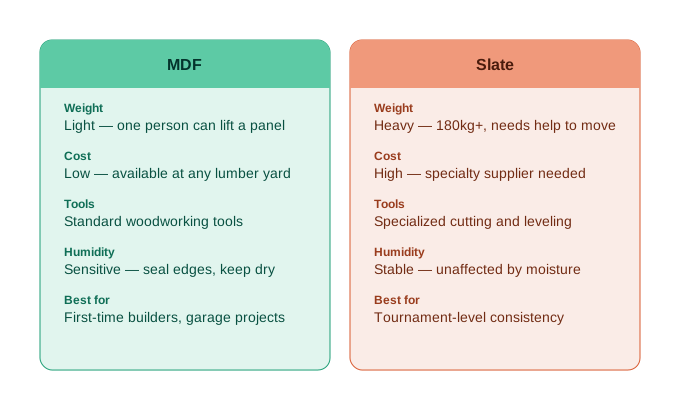
If you are building your first pool table, don't own a forklift, and want a project you can realistically finish in a garage or basement over a few weekends, MDF is almost always the right call. It keeps the project affordable, manageable in weight, and achievable with a standard set of woodworking tools. See our full cost breakdown for what an MDF build typically costs versus buying a table.
Slate makes sense if you already have experience with heavy materials, have help available for moving and leveling, and specifically want tournament-level consistency for serious play.
Getting the flatness right, whichever you choose
Once the surface itself is sorted, the next big step is installing the felt — but flatness has to be right first, since felting won't fix an uneven surface.
- Build your base frame first and check it for level in multiple spots before attaching the playing surface. See our tools guide if you're not sure what you'll need for this step.
- With MDF, use a thickness of at least 3/4" (19mm), and consider doubling up layers for extra rigidity.
- Let the surface acclimate to the room for a few days before final assembly, especially with MDF.
- Check level again after the felt is installed — the added tension can reveal small high or low spots.
Want the full, illustrated build plans?
"How to Build a Pool Table" walks you through the entire process step by step, including a complete MDF-based build and a full felt installation guide.
Download eBook $19.78